Restaurant AI Agent for Smarter Restaurant Operations
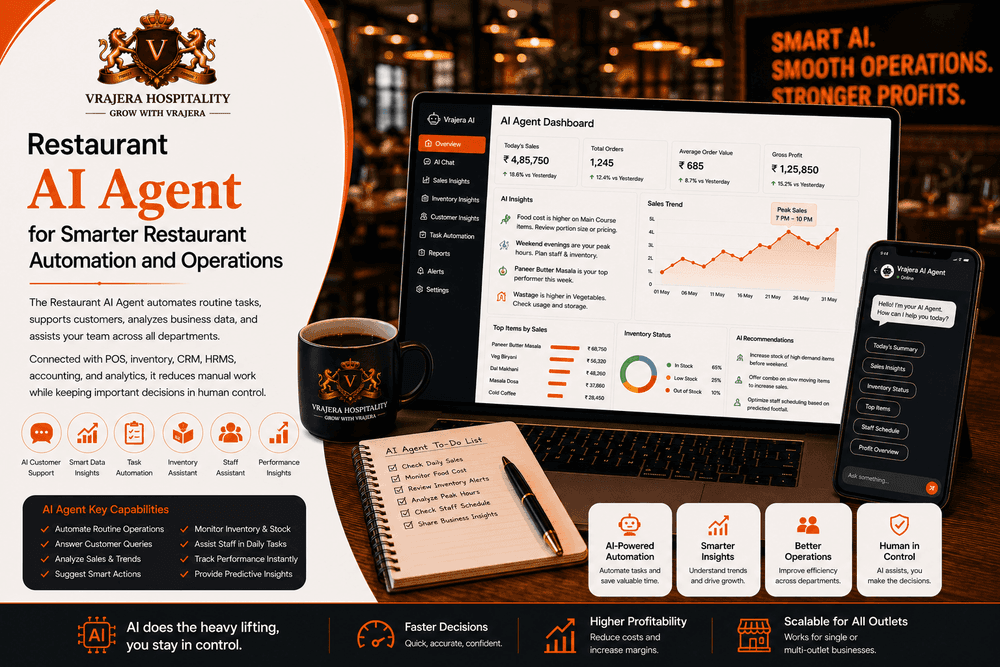
A Restaurant AI Agent is an intelligent software assistant designed to help restaurants handle routine tasks, understand business information, support customer interactions, and assist employees and managers with everyday operations.
Restaurants already generate large amounts of data through orders, billing, inventory, customers, employees, purchasing, accounting, and analytics. The next step is not simply collecting more data. It is making that information easier to use.
An AI agent can act as an intelligent layer across connected restaurant systems. Instead of manually opening several reports or repeating the same administrative tasks, restaurant teams can use AI assistance to find information, understand patterns, and automate suitable workflows.
The important principle is simple: AI should support restaurant teams, not remove necessary human judgment.
What Is a Restaurant AI Agent?
A Restaurant AI Agent is an AI-powered software system that can understand requests, work with permitted restaurant information, and assist with defined tasks or workflows.
Depending on system capabilities, permissions, integrations, and business configuration, a restaurant AI agent may help with:
- Customer queries
- Reservation-related assistance
- Order-related support
- Business information retrieval
- Inventory insights
- Sales analysis
- Customer information
- Management summaries
- Routine workflow automation
Unlike a basic chatbot that mainly responds to questions, an AI agent can potentially work across connected systems and take approved actions within defined boundaries.
Chatbot vs Restaurant AI Agent
| Capability | Basic Chatbot | Restaurant AI Agent |
|---|---|---|
| Answer Questions | Yes | Yes |
| Understand Business Context | Limited | Broader |
| Connected Restaurant Data | Limited | Can Be Connected |
| Workflow Assistance | Basic | Advanced |
| Operational Insights | Limited | Contextual |
| Approved Actions | Usually Limited | Possible |
| Human Oversight | Required | Required |
How Restaurant AI Agents Work
A useful restaurant AI agent requires more than a language model. It needs access to accurate, permitted business information and clearly defined workflows.
Understand the Request
The AI agent first interprets what the customer, employee, manager, or owner is asking.
For example, a manager might ask about yesterday's sales, low-stock ingredients, or an operational trend.
Access Relevant Restaurant Information
Where permissions and integrations allow, the agent can use relevant information from connected restaurant systems.
This may include data from POS, inventory, CRM, HRMS, accounting, or analytics.
Provide Contextual Assistance
Instead of returning raw records, the AI agent can help summarize or explain relevant information.
Take Approved Actions
Where specifically supported and authorized, an AI agent may assist with predefined actions or workflows.
Important financial, operational, employee, customer, and compliance-related decisions should remain subject to appropriate human controls.
AI Agent for Restaurant Operations
Restaurant operations contain many repetitive tasks that can benefit from intelligent assistance.
Daily Business Summaries
An AI agent can help turn restaurant data into easier-to-read management summaries.
Owners may want to understand important changes in sales, inventory, customers, or other operational areas without manually reviewing multiple dashboards.
Operational Questions
Managers could use conversational interfaces to ask questions such as:
"What were yesterday's sales?"
"Which ingredients need attention?"
"Which outlet had the strongest revenue?"
The usefulness of each answer depends on the quality and availability of connected business data.
Exception-Based Assistance
AI can be particularly useful when it helps management focus on unusual situations instead of reviewing every normal transaction.
For example, significant changes in costs or inventory may deserve investigation.
Restaurant AI Agent for Customer Service
AI agents can also support selected customer-facing interactions.
Customer Questions
AI assistance may help respond to common questions involving restaurant information, subject to the data and workflows made available to the system.
Reservation Assistance
Where connected with an appropriate reservation workflow, AI may support customers seeking booking information or assistance.
Order-Related Assistance
AI can potentially support relevant order interactions when integrated with approved restaurant ordering systems.
Human Escalation
Not every customer situation should be handled entirely by AI.
Complaints, sensitive requests, unusual circumstances, or cases requiring judgment should be escalated to restaurant staff when appropriate.
AI Agent for Restaurant Owners
Restaurant owners often need answers, not more reports.
Ask Business Questions Naturally
Conversational AI can make restaurant information easier to access by allowing owners to ask questions in normal language.
Understand Business Changes
If sales, costs, inventory, or other metrics change, an AI assistant can help summarize related available information for management review.
Management Briefings
AI-generated summaries can help restaurant owners quickly understand important business developments.
Any important decision should still be validated against reliable source data.
AI Agent for Inventory and Purchasing
Inventory is a strong use case for AI assistance because restaurants manage changing demand, stock levels, ingredient prices, and purchasing requirements.
Low-Stock Assistance
AI can help surface relevant low-stock information when connected with inventory data.
Inventory Pattern Analysis
Historical stock and sales information can provide useful context for identifying inventory patterns.
Purchasing Support
AI may help management review relevant inventory, consumption, supplier, and purchasing information before procurement decisions are made.
Human Approval for Purchases
AI recommendations should not automatically become purchasing commitments unless the business has deliberately configured appropriate approval controls.
AI Agent for Restaurant CRM
AI can help restaurants use customer information more effectively where appropriate permissions and reliable customer data exist.
Customer Information Assistance
Authorized teams may use AI to find or summarize relevant customer information more efficiently.
Customer Segmentation Support
AI can assist with identifying patterns within permitted customer data.
Personalized Communication
Customer information may support more relevant communication, but restaurants should maintain appropriate privacy, consent, and marketing controls.
Customer Retention Insights
Connected CRM and transaction information may help management understand repeat-customer patterns and retention opportunities.
AI Agent for Restaurant Analytics
Restaurant analytics often requires owners to move between multiple dashboards and reports.
Conversational Analytics
An AI agent can provide a conversational layer over connected restaurant analytics.
Instead of manually finding every report, owners can ask questions and receive summarized answers based on available data.
Explain KPI Changes
If a KPI changes significantly, AI can help surface related information that management may want to investigate.
It should not automatically claim that correlation proves the cause.
Identify Trends
AI can assist in highlighting patterns across historical restaurant data.
Management should still consider seasonality, local events, operational changes, and other real-world context.
Multi-Outlet Restaurant AI Agent
AI agents can become especially useful for restaurant chains because management must understand information across many locations.
Centralized Business Questions
Owners may want to ask questions across the restaurant group rather than opening individual outlet reports.
Outlet Comparisons
AI can help summarize relevant differences across restaurant locations using connected business information.
Multi-Outlet Exceptions
Instead of manually monitoring every location, AI can help surface unusual patterns that may deserve management attention.
Maintain Local Context
AI should not assume every outlet operates under identical conditions.
Location, format, customer demand, pricing, staffing, and operating hours may all influence performance.
Human Control and Responsible Restaurant AI
AI automation should be useful, explainable, and appropriately controlled.
Keep Important Decisions Human-Led
Restaurants should maintain human approval for sensitive actions involving:
- Financial commitments
- Employee decisions
- Customer disputes
- Pricing changes
- Vendor commitments
- Compliance matters
Role-Based Access
AI should only access business information appropriate to the user's role and permissions.
Protect Customer and Employee Data
Restaurant AI systems should follow appropriate privacy, security, consent, and data-governance practices.
Verify Important AI Outputs
AI-generated summaries and recommendations can be useful, but important business decisions should be checked against reliable restaurant records.
Vrajera Restaurant AI Agent
Vrajera Restaurant AI Agent fits within a broader AI-powered Restaurant Commerce OS designed to connect restaurant operations and business information.
AI Connected with Restaurant Operations
Vrajera's broader platform is designed around restaurant functions such as:
- POS and billing
- Inventory
- Purchasing
- CRM
- HRMS
- Accounting
- Analytics
Connecting these areas creates a stronger foundation for useful restaurant AI.
From Restaurant Data to AI Assistance
An AI agent becomes more valuable when it can work with relevant connected business information rather than operating as an isolated chatbot.
This can help restaurant teams access information and understand operational context more efficiently.
AI for Owners and Managers
Vrajera's AI direction can support a more conversational approach to restaurant management, where authorized owners and managers interact with business information through intelligent assistance.
AI with Human Oversight
Restaurant automation should maintain appropriate approvals and human control.
The goal is to reduce repetitive work and improve access to business intelligence—not to remove responsible management.
Why Restaurants Consider Vrajera AI
Vrajera combines the foundation of a Restaurant Commerce OS with AI-powered capabilities.
By connecting AI with restaurant operations, businesses can move toward a system that does more than record transactions. It can help authorized teams understand information, identify relevant patterns, and manage routine workflows more efficiently.
Conclusion
Restaurant AI Agents represent an important shift from traditional restaurant software toward intelligent operational assistance.
Instead of only storing transactions and generating reports, AI agents can help restaurant owners, managers, employees, and customers interact with connected business information more naturally.
The strongest restaurant AI systems will combine automation with accurate data, clear permissions, privacy controls, and human oversight. Vrajera brings AI into the wider Restaurant Commerce OS, creating a foundation for smarter restaurant operations without removing the judgment and responsibility of restaurant teams.
Frequently Asked Questions
What is a Restaurant AI Agent?
A Restaurant AI Agent is an AI-powered software assistant that can understand requests, work with permitted restaurant information, provide contextual assistance, and support defined workflows.
How is a Restaurant AI Agent different from a chatbot?
A chatbot mainly answers questions, while an AI agent can potentially work with connected business systems, understand broader operational context, and assist with approved workflows.
What can an AI agent do for restaurants?
Depending on integrations and capabilities, AI agents can support customer questions, business summaries, analytics, inventory insights, CRM assistance, management queries, and routine operational workflows.
Can a Restaurant AI Agent manage multiple outlets?
Yes. When connected with multi-location restaurant data, an AI agent can help authorized users review information and patterns across different outlets.
Should restaurants allow AI to make decisions automatically?
Sensitive financial, employee, customer, pricing, vendor, and compliance decisions should maintain appropriate human review and approval controls.
Why choose Vrajera Restaurant AI Agent?
Vrajera connects AI with a broader Restaurant Commerce OS covering POS, inventory, purchasing, CRM, HRMS, accounting, analytics, and restaurant operations, creating a stronger foundation for useful AI assistance.