Restaurant Menu Performance Analysis for Smarter Menu Decisions
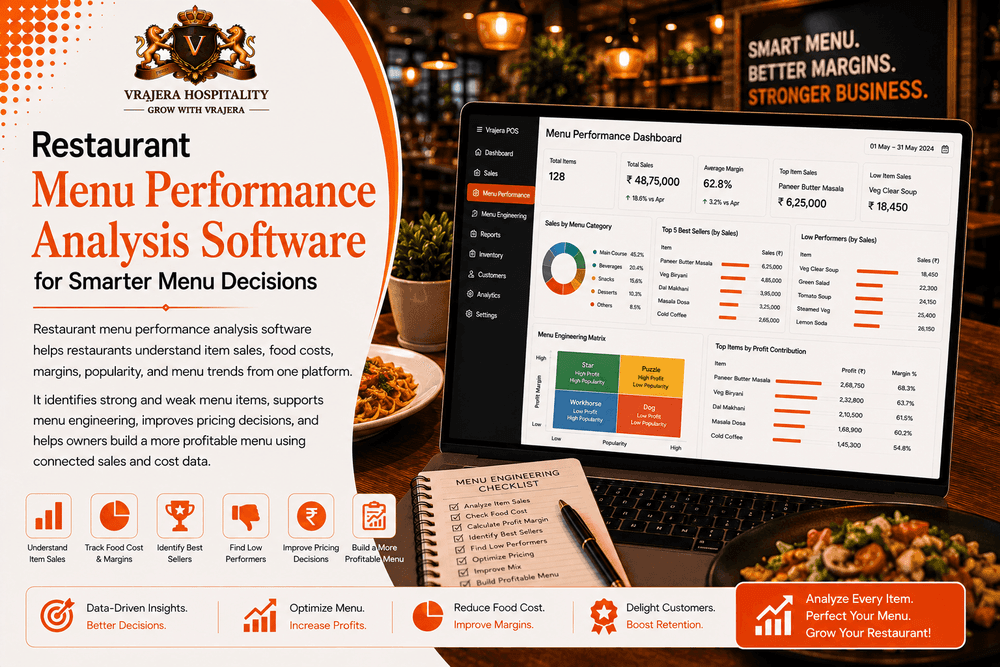
Restaurant menu performance analysis helps owners understand which menu items customers order, which products contribute useful margins, which dishes are losing momentum, and where menu decisions may need attention.
A popular dish is not automatically a profitable dish. Similarly, an item with lower sales may still contribute strong margins or serve an important role within the menu.
Useful menu analysis therefore combines sales information with recipe costs, ingredient costs, pricing, customer demand, and profitability rather than judging every dish by sales volume alone.
What Is Restaurant Menu Performance Analysis?
Restaurant menu performance analysis is the process of reviewing menu-item data to understand how individual products and categories contribute to restaurant performance.
Depending on available data, restaurants can analyze:
- Menu item sales
- Order quantity
- Selling price
- Recipe cost
- Food cost
- Gross contribution
- Item popularity
- Menu trends
The objective is to help management make informed menu decisions instead of relying only on assumptions about what customers like.
Basic Menu Reports vs Menu Performance Analytics
| Area | Basic Menu Report | Menu Performance Analysis |
|---|---|---|
| Item Sales | Yes | Yes |
| Popularity | Basic | Analyzed |
| Recipe Cost | Separate | Connected |
| Food Cost | Separate | Compared |
| Margin Context | Limited | Stronger |
| Menu Trends | Manual | Easier to Identify |
| Decision Support | Descriptive | More Actionable |
Menu Item Sales Analysis
Sales information provides the starting point for understanding menu performance.
Identify Best-Selling Menu Items
Restaurant analytics can help owners understand which products consistently generate high order volume.
This information can support:
- Kitchen preparation
- Ingredient planning
- Purchasing
- Inventory management
- Menu positioning
Find Low-Selling Items
Low sales do not automatically mean an item should be removed.
Management should investigate whether the item has low visibility, seasonal demand, limited customer awareness, pricing concerns, or another specific role within the menu.
Analyze Sales Over Time
Comparing menu-item performance across relevant periods can reveal whether customer demand is increasing, declining, or changing seasonally.
Menu Profitability Analysis
Menu performance becomes more useful when sales are connected with costs.
Connect Selling Price with Recipe Cost
Restaurant owners can compare menu prices with relevant recipe and ingredient costs to better understand item economics.
Understand Contribution
A high-selling item with weak margins may contribute differently from a moderately popular item with stronger economics.
Both sales volume and profitability should therefore be considered.
Monitor Food Cost Changes
Ingredient prices change over time.
If recipe costs increase while selling prices remain unchanged, the profitability of a menu item may decline even when its sales remain strong.
Review Profit Opportunities
Connected analytics can help management identify products that may require deeper review of pricing, portions, recipes, purchasing, or positioning.
Menu Engineering
Menu engineering combines popularity and profitability to provide better context for menu decisions.
High Popularity, Strong Profitability
Items performing well across both dimensions may deserve strong menu visibility and consistent inventory availability.
High Popularity, Lower Margin
Popular items with weaker margins may require a review of recipe costs, portions, supplier pricing, or selling price.
Lower Popularity, Strong Margin
Profitable but less frequently ordered items may benefit from better menu placement, staff awareness, or appropriate promotion.
Lower Popularity, Lower Margin
These products may require deeper review, but removal should not be automatic.
Seasonality, menu completeness, customer expectations, and strategic value should also be considered.
Food Cost and Recipe Analytics
Menu decisions become stronger when analytics connect with recipe and inventory information.
Recipe Cost Visibility
Standard recipe costing helps restaurants understand the ingredient cost behind each menu item.
Ingredient Price Changes
Supplier price increases can affect menu profitability even when customer demand remains unchanged.
Portion Consistency
Standardized recipe quantities can improve both food-cost accuracy and customer consistency.
Wastage Context
If an ingredient used by a particular menu category generates frequent wastage, management may need to investigate purchasing, preparation, or menu planning.
Category and Product Mix Analysis
Restaurant menus often contain multiple product categories with different roles.
Compare Menu Categories
Restaurants can review relevant performance across categories such as:
- Starters
- Main courses
- Beverages
- Desserts
- Combos
- Other menu groups
Understand Product Mix
Changes in what customers order can affect revenue, food cost, and profitability even when total order volume remains stable.
Identify Changing Preferences
Historical menu analytics can help management understand how customer demand changes over time.
This can provide useful context when updating seasonal or permanent menus.
Menu Pricing Decisions
Analytics can support pricing decisions, but price should never be changed based on one metric alone.
Review Price and Cost Together
Menu pricing should consider relevant factors such as:
- Recipe cost
- Ingredient prices
- Target margins
- Customer demand
- Market positioning
- Portion value
Avoid Blind Price Increases
Increasing prices solely because costs have risen may affect customer demand.
Management should consider the full product and customer context.
Use Data as Decision Support
Analytics should support restaurant judgment rather than replace it.
Food quality, customer expectations, brand positioning, and competitive conditions remain important.
Multi-Outlet Menu Performance Analysis
Restaurant chains may discover that the same menu performs differently across locations.
Compare Item Performance by Outlet
Management can review relevant menu information according to individual restaurant locations.
Understand Local Customer Demand
Customer preferences may vary by:
- City
- Neighborhood
- Outlet format
- Customer profile
- Local competition
Menu performance should therefore be interpreted within local context.
Centralized Menu Insights
Restaurant groups can maintain a broader view of menu performance while investigating location-level differences when needed.
Vrajera Menu Performance Analytics
Vrajera Menu Performance Analytics forms part of a broader Restaurant Analytics Software and Restaurant Commerce OS designed around food-business operations.
Connect Menu Sales with POS
Vrajera can connect relevant POS and billing information with menu analytics, providing a stronger foundation for understanding product demand.
Connect Menu Items with Recipe Costs
Menu profitability becomes more meaningful when sales information can be viewed alongside recipe, ingredient, inventory, and food-cost information.
Connect Menu Performance with Customers
Where appropriate customer data is available, CRM information can provide additional context around menu preferences and purchasing behaviour.
Multi-Outlet Menu Visibility
Restaurant groups can review centralized menu information while maintaining relevant outlet-level visibility.
Why Restaurants Consider Vrajera Menu Analytics
Vrajera connects menu performance with the operational systems that create sales and cost information.
Instead of looking only at item sales, restaurant owners can understand menu performance within the broader context of recipes, inventory, food costs, customers, and profitability through one Restaurant Commerce OS.
Conclusion
Restaurant menu performance analysis helps food businesses understand which products customers prefer, how individual dishes contribute financially, and where menu opportunities may exist.
The strongest menu decisions combine popularity, recipe costs, food costs, pricing, margins, customer behaviour, and operational context. Vrajera connects menu analytics with the wider Restaurant Commerce OS, helping restaurant owners turn menu data into clearer decisions about pricing, purchasing, inventory, and profitability.
Frequently Asked Questions
What is restaurant menu performance analysis?
Restaurant menu performance analysis reviews menu-item sales, popularity, costs, pricing, and profitability to help owners understand how different products contribute to business performance.
What restaurant menu metrics should owners track?
Useful metrics may include item sales, order quantity, selling price, recipe cost, food cost, margin information, popularity, and changes in demand over time.
What is restaurant menu engineering?
Menu engineering evaluates menu items using factors such as popularity and profitability to provide better context for menu placement, pricing, promotion, and product decisions.
Should restaurants remove every low-selling menu item?
No. Low sales should be investigated in context. Seasonality, menu positioning, profitability, customer expectations, and strategic value may all affect whether an item should remain.
Can menu analytics compare multiple restaurant outlets?
Yes. Multi-location analytics platforms can organize menu performance by outlet while providing centralized visibility across the restaurant group.
Why choose Vrajera for menu performance analysis?
Vrajera connects menu sales with POS, recipe costing, inventory, food costs, CRM, accounting, and analytics through one Restaurant Commerce OS, providing stronger context behind menu performance.